- Bangladesh
- Belgium
- Canada
- China
- Egypt
- Germany
- India
- Indonesia
- Japan
- Morocco
- Netherlands
- Pakistan
- Poland
- Spain
- Sri Lanka
- Tunisia
- Turkey
- UK
- USA
- Vietnam
Turkey as a Strategic Nearshoring Hub for EU Apparel Brands
$33B
T&A Exports (2023)
$19B
Apparel Contribution in the T&A Exports (2023)
Sitting at the crossroads of the EU and Asia, Turkey is the world’s 7th largest textile exporter and the 3rd largest supplier to the EU, serving key markets like Germany, Spain, UK, and the Netherlands. It serves as a key nearshoring hub for EU brands seeking speed, responsiveness, and lower inventory risk. It exports 60% of its apparel production. Major brands sourcing from Turkey include Boss, Inditex, Mango, Bestseller and Primark
Sources: Republic of Türkiye – Clothing, Is Turkey an Emerging Global Sourcing Hub
Largest Cotton Producer in EU
$2.76B
Cotton Import
Turkey is Europe’s largest cotton producer but remains heavily reliant on imports of both cotton and man-made fibres, with particularly high dependence on synthetic raw materials. Main cotton exporting countries to Turkey are the U.S., Uzbekistan, Brazil, Greece, and India. In 2021, it exported $18.3 billion worth of apparel, about 60% of which was cotton-based. The country also contributes 15% of Western Europe’s synthetic fibre output. Turkey’s fabric industry is strongly export-oriented, dominated by woven fabrics (62% of production value) and followed by knitted fabrics (38%), while it ranks as the world’s 5th largest denim exporter.
Vertical Integration Driving Turkey’s Global Apparel Trade
25%
Active Exporters Out of 44000 firms
Turkey’s T&A industry operates on a vertically integrated model, which reduces lead times, ensures raw material security, and supports broad product diversification. This integration positions Turkey as a reliable sourcing alternative for global brands. The sector is dominated by SMEs, enabling both small-batch and large-scale production without the need for long pre-orders. Over time, the industry has shifted from low-value to high-value goods reflecting skilled labor, strong design and tech investment.
SourcesTextile Recycling Driven by Mechanical Downcycling
180
Textile Recycling Factories
485kT
Recycled Fibre Generated per Year
Turkey’s textile recycling sector is centered in the Usak and Izmir regions, primarily operating mechanical downcycling units that process pre-consumer waste. While post-industrial waste is efficiently managed, post-consumer waste remains underutilized due to weak collection and recycling systems. Most of the recycled yarn produced is exported.
Notes:
- Uşak stands as a central hub for textile recycling due to its large number of recycled fiber and yarn manufacturers that process discarded textiles. Sources
- Turkey generates about 1,300 kT of textile waste annually with 63% pre-consumer and 37% post-consumer waste.
Key regions with apparel production:
Istanbul, Bursa, Izmir, Denizli, Gaziantep, Kahramanmaras
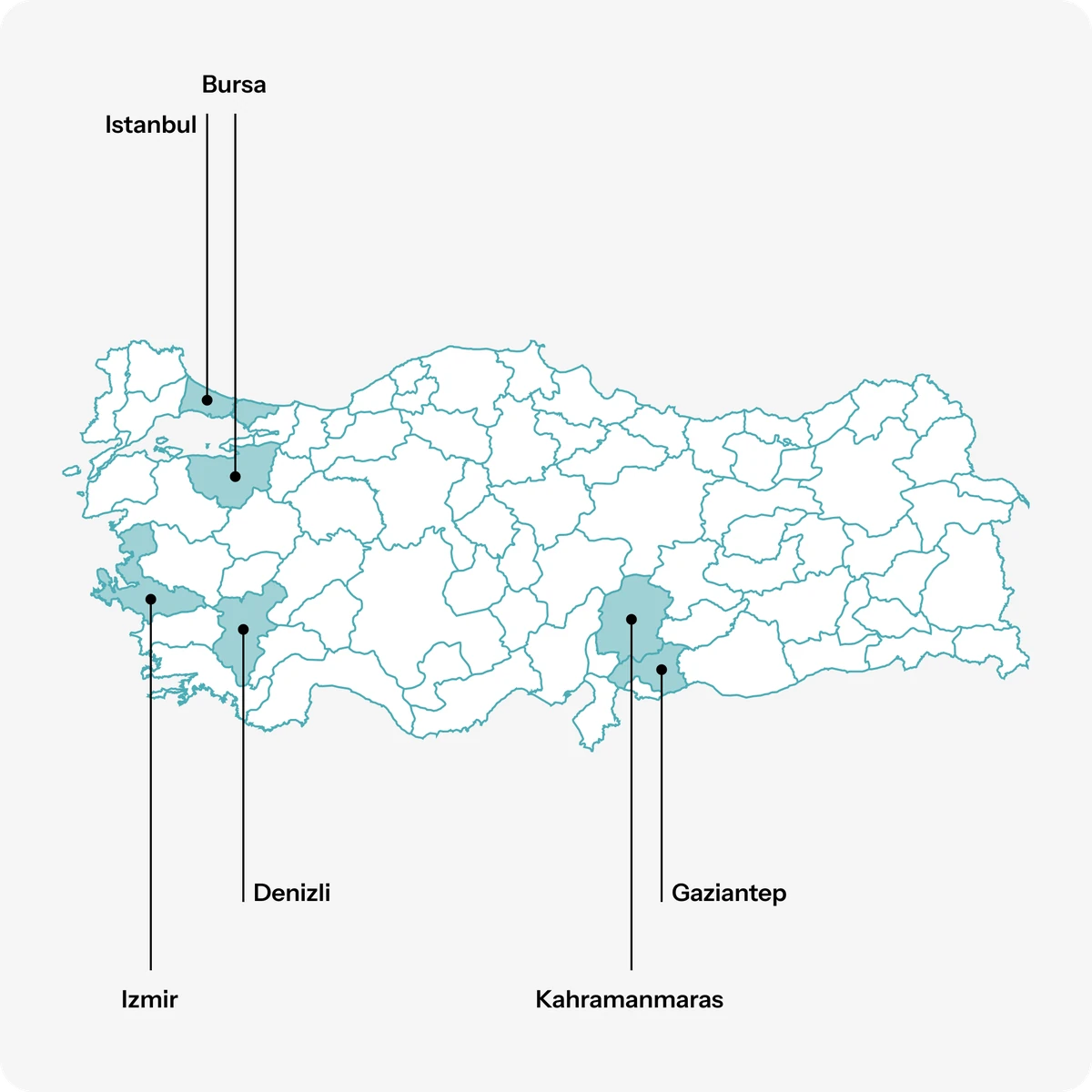
Key regions with fibre production:
Bursa ( holds 70% of Turkey’s man-made fibre output), Izmir, Aydin, Adana, Hatay, Şanlıurfa
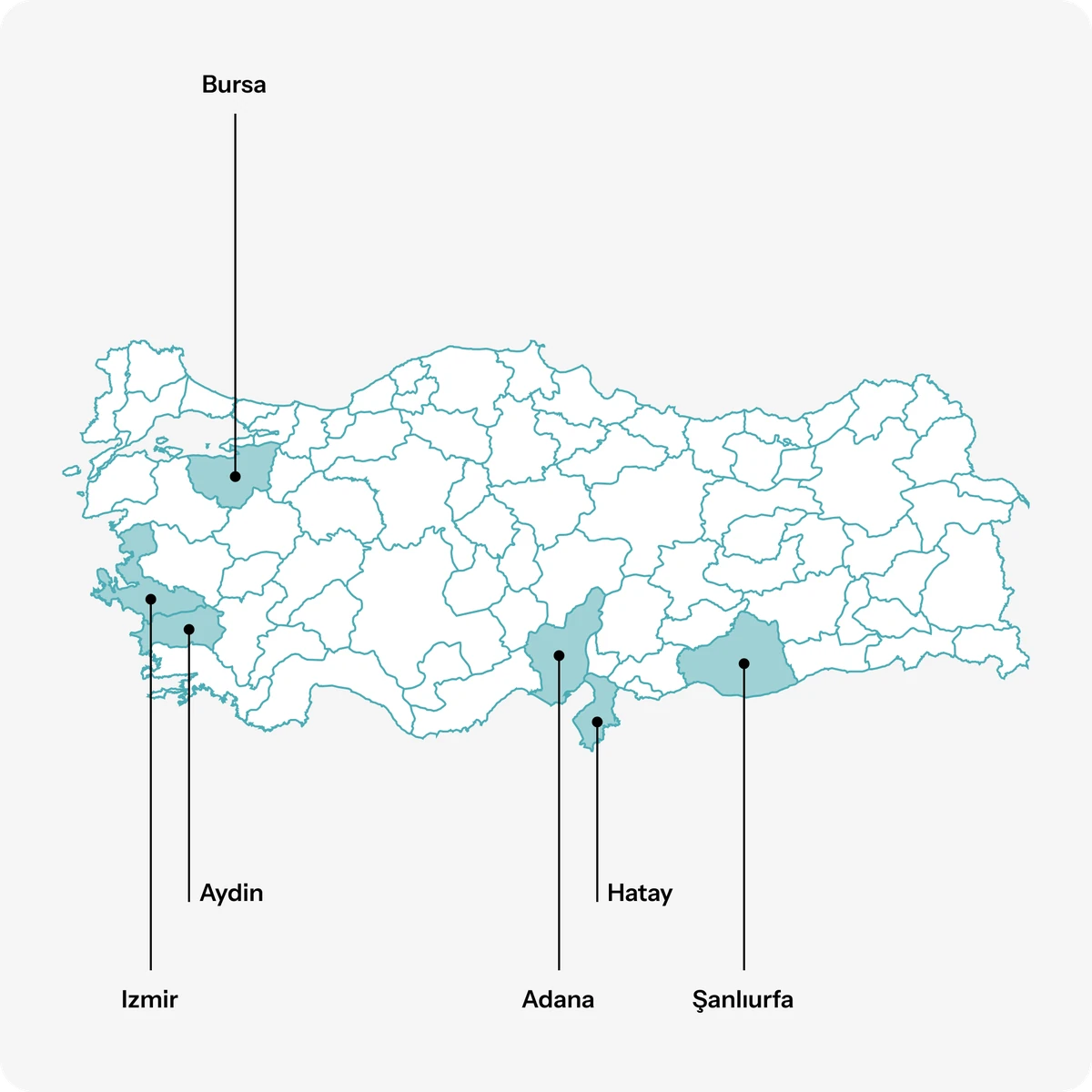
Notes:
- The Turkish textile and apparel sector employs 7% of registered workers and 65% of manufacturing jobs, with women comprising 41% of the workforce—well above the national average. Its strong labour standards and social compliance align with EU expectations, appealing to brands focused on ethical sourcing. Sources
- Turkish clothing manufacturers are implementing sustainable production, international standards and blockchain technology for transparency as a response to rising demand for eco-friendly fashion. Sources
- Major apparel manufacturers include – Akcakaya Textile, Konsey Textile, Zeria Textile and fibre producers like Kipas Textile, Gurteks and Kaynak Group
- The Turkish T&A sector is facing employment declines and firm closures due to economic pressures, leading some companies to shift production to lower-cost countries, particularly Egypt, to stay competitive
- Turkish T&A exporters view the recent additional U.S. tariff of 15%, as an opportunity to expand market share in USA, particularly as competing supplier countries face significantly higher rates. This relative advantage is expected to strengthen Turkey’s position by leveraging its established reputation for high product quality
- Egypt is emerging as a key supplier to Turkey, as rising domestic costs are pushing Turkish firms to offshore production, aided by Egypt’s low-cost advantage and the Turkey-Egypt Free Trade Agreement (FTA)
The Turkish Textile Industry Sustainability Action Plan
Spearheaded by İTHİB and TİM, this initiative aligns the sector with the European Green Deal and global sustainability goals. It targets 55% textile waste recycling by 2025 and 65% by 2035, focusing on sustainable sourcing, resource efficiency, circularity, and industry-wide collaboration across 12 action areas including digitalization, financing, and green skills development.
SourcesZero Waste campaign
Launched in 2017 by the Turkish Red Crescent, this nationwide initiative promotes waste prevention and sustainable resource use. Backed by the 2019 Zero Waste By-law, it aims to raise textile recycling rates to 35% within five years by building a national collection and recycling system for unused or discarded textiles, including material recovery from used garments.
SourcesEBRD Near Zero Waste (NØW) Program
Offers concessional financing and technical assistance for waste minimization and pollution control in textile production.
Turkish Eximbank Green Export Credit ($300M)
Provides favourable loan terms to exporters implementing eco-friendly manufacturing.
Circular Economy Platform
It is a national initiative launched by the Business Council for Sustainable Development Turkey and the European Bank for Reconstruction and Development ( EBRD ) to accelerate the transition to a circular economy model. It offers tools such as a digital marketplace, knowledge hub, measurement and training resources, financial incentives, and consultancy to help businesses develop circular practices and investments.
SourcesIntegrated Pollution Prevention & Control Communique in the Textile Sector
It sets procedures to minimize the industry’s environmental impact by regulating emissions, discharges, and waste released into air, water, and soil. It promotes cleaner production, efficient use of raw materials and energy, and eco-friendly management practices. The regulation applies to textile facilities with capacities above 10 tons/day engaged in processes such as washing, bleaching, mercerisation, dyeing, printing, and finishing.
60.85 kTon
Import quantities
(HS 6309, 631010) – 2024
99.15 kTon
Export quantities
(HS 6309, 631010) – 2024
Notes:
- Under Clause 7 of Turkey’s Import Regime Decision, importing used clothing, rags, and textile waste is generally banned to protect local production. Exceptions exist under the Inward Processing Regime for non-final textile inputs meant for export, and the Ministry of Trade allows certain recycled polyester fibres and synthetic yarns to support sustainability. Additionally, Turkey’s recycling sector imports cotton-rich pre-consumer waste from countries like Bangladesh and South America. Sources
- Recycling of post-consumer waste from the EU serves as a big business area in established recycling production sites of GAMA Iplik, Else Bornewa, Kale Iplik, Dünya Iplik, Kipas, ISKO, and Bossa. Sources
12.02%
Share of modern renewables in final energy consumption (2021)
48.7%
Renewable electricity generation: Renewable electricity generation by source- hydro
26%
Renewable electricity generation: Wind
16.8%
Renewable electricity generation: Solar
8.5%
Renewable electricity generation: Geothermal
Notes:
- Green Transformation Grant Program: This program supports the textile and RMG sectors in transitioning to a green economy through a 10 million lira grant pool and credit access via Eximbank, TÜBİTAK, and others. It promotes sustainability and competitiveness by incentivizing green investments. Sources
- KOSGEB SME Grants & Loans: The program provides SMEs with interest-free loans, grants, and guarantees for innovation, R&D, and green transformation, supporting sustainable growth. It also offers special support for businesses lacking collateral or aiming to expand responsibly. Sources
- Sustainable Export Finance Programs: Offered by Turk Eximbank, provide long-term, low-cost financing to exporters, including textile firms, with a focus on women-led SMEs and green product exports. These loans are tied to sustainability goals and support climate-resilient upgrades, renewable energy adoption, and eco-friendly practices in textile manufacturing and exports.