- Bangladesh
- Belgium
- Canada
- China
- Egypt
- Germany
- India
- Indonesia
- Japan
- Morocco
- Netherlands
- Pakistan
- Poland
- Spain
- Sri Lanka
- Tunisia
- Turkey
- UK
- USA
- Vietnam
High dependence on imports for apparel products
98.5%
Import penetration rate for apparel products, on a volume basis (2022)
51.0%
Apparel products imported from China (2023)
Source: Measures to Strengthen Supply Chain Resilience in Textile Production Areas
The domestic production rate of apparel products is low. China accounts for half of clothing imports, followed by Vietnam, Bangladesh, and Myanmar.
Highly acclaimed fabric production
30.7%
of Japan’s textile exports were fabrics (2023)
• Domestic production is dominated by midstream products and synthetic fibers. As for exports, fabrics account for the largest proportion and are highly valued.
• While some companies cover all stages from upstream to downstream, midstream production, particularly textile production, forms “production area” in which local companies divide the work and specialize in yarn manufacturing, fabric manufacturing, dyeing and finishing, and sewing.
Sources: FY2024 Comprehensive Critical Technology Management Project (Survey on Industrial Data Collaboration) – Report, Measures to Strengthen Supply Chain Resilience in Textile Production Areas, Current State and Policy of the Textile Industry
Competitive, advanced recycling technology
• Competitive and advanced recycling technology
• Strong technological capabilities and development capabilities regarding high-performance, high-value-added fibers and high-function fibers
• Polyester, which accounts for more than half of fiber production, Japan has several companies with competitive technology that can recycle it to a quality equivalent to virgin fiber, and has been developing this technology for many years.
Sources: Textile Technology Roadmap, Technology Development for Establishing a Resource Circulation System for Textile Products
Expanding textile collection systems by 2030
• As of 2025, approximately 630,000 tonnes of clothing are discarded by households in Japan each year. Of this amount, 440,000 tonnes are disposed of as general waste, while 190,000 tonnes are collected through municipal and private collection schemes. Of the 190,000 tonnes collected through these schemes, 100,000 tonnes are exported overseas as used clothing, 10,000 tonnes are reused domestically, and 60,000 tonnes are mechanically recycled.
• The Ministry of the Environment plans to expand both municipal and private-sector collection (such as the installation of collection boxes at retail stores), to promote the reuse and recycling of discarded clothing.
• By 2030, it aims to increase municipal collection by approximately 41,000 tonnes and in-store collection by approximately 26,000 tonnes, which represents an approximately 30% increase compared with 2020 levels. To support the expansion of clothing collection by municipalities, the Ministry published the “Good Practices for Used Clothing Collection: For Municipalities and Businesses” in March 2026 and plans to develop guidelines for municipalities on clothing collection by March 2027.
Sources: MOE Material Flow of Clothing, Action Plan for Promoting Sustainable Fashion, Good Practices for Used Clothing Collection: For Municipalities and Businesses, Guidelines for Used Clothing Collection for Municipalities
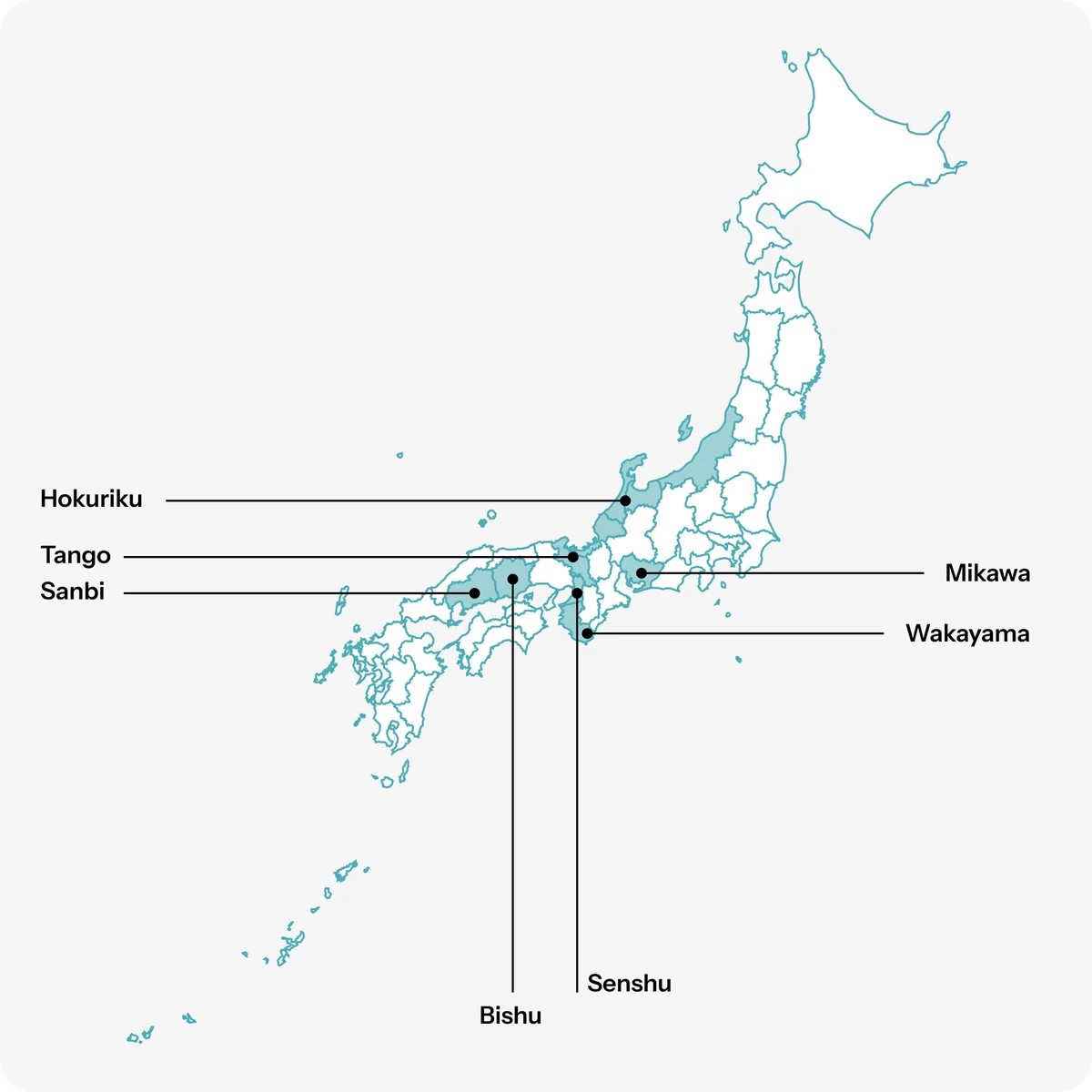
Key regions with fibre production:
Hokuriku(Silk textiles, synthetic textiles, knits), Bishu(Wool textiles), Mikawa,(Cotton textiles, Synethic textiles), Tango(Silk textiles), Senshu (Cotton textiles, knits, towels), Wakayama(knits), Sanbi (Cotton textiles (denim))
Notes:
- While Japanese textiles are highly valued by overseas brands, the apparel industry is increasingly dependent on imports from China and Southeast Asia, weakening its ties with the domestic textile industry. Sources
- Businesses in production areas face numerous challenges. The aging of management and labor shortages are becoming increasingly serious. In particular, family businesses are facing increasing difficulties in continuing operations due to the lack of successors. Furthermore, price competition with inexpensive overseas products is driving down prices and sales of locally produced goods, leading to a decline in the number of businesses. Sources: Current State of Japan’s Domestic Textile Industry, Measures to Strengthen Supply Chain Resilience in Textile Production Areas
Resource Circularity Roadmap for Textile Products (Ministry of Economy, Trade and Industry, 2024)
The Japanese government formulated a roadmap for resource circularity in the textile sector in 2024. It aims to establish a resource circularity system and achieve appropriate production and consumption by 2040, setting KPIs to achieve this. Specific targets set for 2030 include a 25% reduction in the amount of clothing discarded from households compared to 2020, and processing 50,000 tons of discarded clothing through fiber-to-textile recycling.
SourcesAction Plan for Promoting Sustainable Fashion (Ministry of the Environment, 2026)
The above-mentioned “Resource Circularity Roadmap for Textile Products” and the 5th Basic Plan for Promoting the Formation of a Circular Economy (Cabinet Decision, August 2024) set government targets for the reduction of clothing discarded from households by 25% compared to 2020. In March 2026, a concrete plan for achieving the target was compiled, including the expansion of clothing collection systems, the expansion of reuse, as well as extending the lifespan of clothes and improving the utilization rate of clothing.
Sources513.34 kTon
Import quantities
(HS 6309, 631010) – 2024
17.10 kTon
Export quantities
(HS 6309, 631010) – 2024
9.26%
Share of modern renewables in final energy consumption (2022)
6%
Renewable electricity generation: Wind
49.2%
Renewable electricity generation: Solar PV
42.9%
Renewable electricity generation: Hydro
1.9%
Renewable electricity generation: Geothermal